

Years of violent conflict in Mangu, a Local Government Area in Plateau State, Nigeria, left deep divisions between two neighbouring communities: Bungha and Derkong. Following the intercommunal violence that happened in 2023 and 2024 between the Mwaghavul people, Fulani, Hausa, and other community members. Fear and mistrust severely limited interaction. Although active violent events had decreased, relationships remained broken, and communities lived in what participants described as “graveyard peace,” or a situation where people were no longer fighting but had stopped interacting with each other because of fear.
As one participant explained: “What we had was graveyard peace. People were quiet, but there was no healing. Everyone stayed on their side because of fear.”
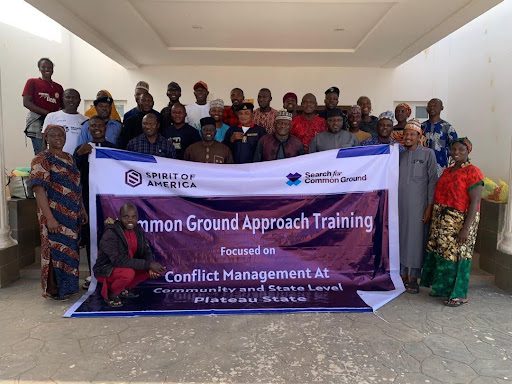
Under a joint initiative between Search for Common Ground and Spirit of America, we engaged community stakeholders through consultations and conflict management training, leading to the establishment of Joint Community Safety and Resilience Committees (CSRCs) in Bungha and Derkong. The initiative also convened a three-day Community Conflict Management Training that brought together community leaders, women, youth, security agencies, and representatives of previously divided groups.
For many participants, it was the first opportunity in almost four years to sit together, engage in dialogue, and jointly analyse the conflicts affecting their communities using the Common Ground Approach, a conflict transformation method that brings people together across dividing lines to understand their differences, discover shared interests, and achieve collaborative solutions.
One participant reflected: “For the first time in years, I sat in the same room with people I had avoided since the crisis. The training helped us see each other as humans again.”
The engagement created an important first step towards rebuilding trust and strengthening community ownership of peacebuilding. Participants who had lived separately for several years reopened communication, exchanged perspectives, and began identifying practical ways to work together to prevent future violence.
Another participant shared: “Three years ago, I told myself I would never have anything to do with Fulani people again. But after the training, especially learning about identity, my perspective has changed completely. God bless the organizers of this training.” Another participant said: “If this continues, we believe it can break the silence that has kept us apart for years.”
The establishment of the CSRCs has also provided a community-owned platform through which local leaders, community members, and security actors can jointly identify emerging risks, promote dialogue, and coordinate early responses to potential conflicts. This shift not only addresses immediate tensions but serves as a foundation for long-term stability in the state, creating a more secure environment where collaborative peacebuilding can take root.
