

Most people think that once two communities see each other as enemies, that’s the story for good.
That competition over scarce resources hardens into something dialogue can manage but never actually change. You keep the peace between them. You don’t expect them to start working together.
Search for Common Ground has seen something different.
Distrust between displaced and host communities doesn’t dissolve through goodwill. It dissolves through shared income. When two groups have a reason to need each other economically, the differences that once defined the relationship stop being the most useful thing to notice about each other.
In a refugee camp in northeastern Kenya, that reason was tie-dye fabric.
Khadija, a 55-year-old grandmother of six, has spent years teaching other refugee women how to weave sisal into baskets and dye fabric for the local market. For years, that work happened despite the surrounding host community, not alongside it.
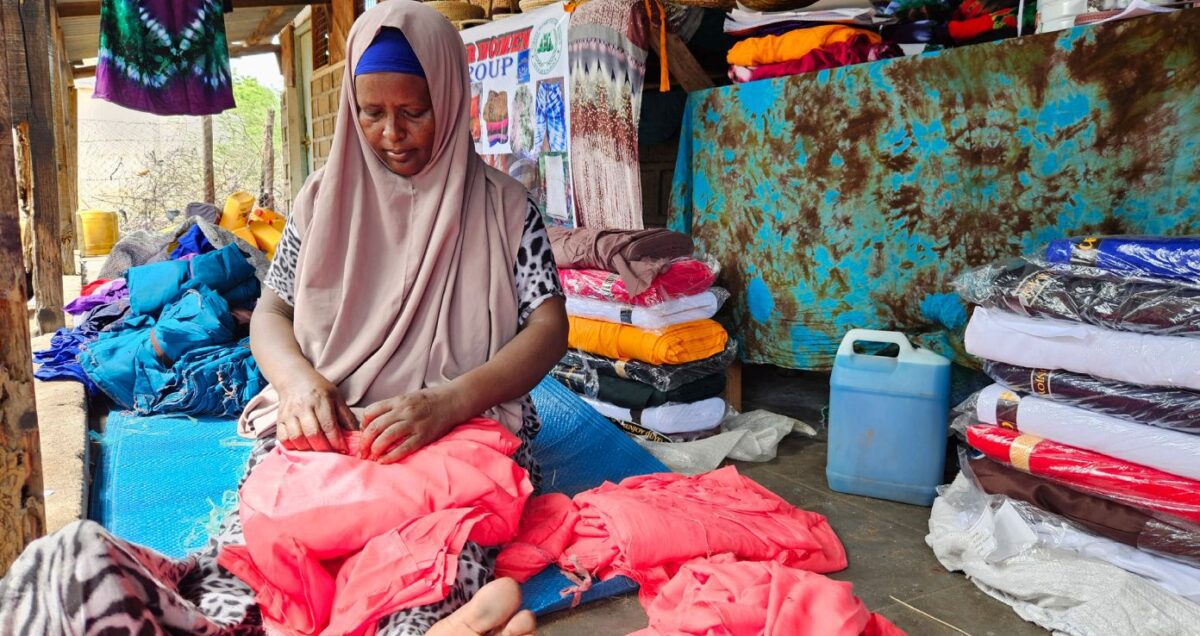
“Locals have always seen us as enemies and not good people at all,” says Fatuma, a mother of eight who was forced to shut her kiosk after repeated break-ins — and after her neighbors stopped buying from her altogether. Fetching firewood carried its own risk. “They will attack and take away what we have gathered the whole day under the scorching sun, saying that it is theirs,” she says.
Then a Search program paired dialogue between the two communities with real market access. The group’s production climbed to 30 rolls of fabric a day — 120 pieces, each selling for the local equivalent of about $8. Monthly profit that used to sit around $75–115 now reaches $225–300.
The more interesting shift happened outside the ledger. Women from the host community started asking to learn the craft themselves.
“We no longer see each other like enemies,” Fatuma says. “They now see us as locals like themselves; they even want to learn how to tie and dye fabrics and earn money like us.”
Nurto puts the change in the plainest terms available to her. “It was hard buying food for my family. All I could afford was a quarter of rice and sugar every day, but with the expansion of our production I can buy food stock for a month and still cater for other needs with ease,” she says.
Your support turns a market stall into the thing two communities finally have in common.
Subscribe to our blog
Receive an email whenever a new blog post is published.
