


The project Strengthening the Rule of Law Framework to Support Religious Freedom in Kyrgyzstan was launched in September 2021 and is a 22-month project to improve the rule of law framework around religious freedom in Kyrgyzstan by strengthening local capacities to address violations of religious rights and improving policies and legislation that strengthen religious freedom in the country.
Context
Despite recent improvements in legal frameworks for religious freedoms, including through Search’s recent work in assisting the development of the Kyrgyz government’s new Concept in Support of the State Policy of the Kyrgyz Republic on Religious Affairs for 2021-2026, discrimination based on religion is still pervasive in Kyrgyzstan. Local communities have limited awareness of religious freedom, judicial actors and community leaders have inadequate capacity to engage on sensitive religious issues, and certain aspects of the newly adopted constitution could present new challenges to religious freedom in the country.
Women face additional barriers to exercising their right to religious freedom, including limited access to leadership positions and widespread opposition to female religious leaders, resulting in religious hierarchies that are unable or unwilling to address women’s issues. There is limited awareness among local communities that religious freedom and equality between men and women are both human rights.
Within this context, Search’s project aims to address these gaps in both local- and state-level capacities in ways that build upon the successes of the new State Concept and increase the efficacy of its implementation. Search is working with its implementing partner the Research Center for Religious Studies (RCRS) and in collaboration with the State Commission on Religious Affairs (SCRA) and the High School of Judges (HSJ) under the Supreme Court of the Kyrgyz Republic to meet its goal of strengthening religious freedoms in Kyrgyzstan.
Theory of Change
IF targeted judicial, legal, and civil society actors have increased capacity and opportunity to collectively mainstream and monitor the religious freedom legal framework while ensuring equality between men and women in the process, and IF targeted local communities, including women, have increased awareness of existing religious freedom legislation and increased opportunities to prevent and address issues related to its implementation in their communities, and IF religious freedom laws and concepts continue to be strengthened through inclusive, policy dialogue at the national level that is sensitive to women’s issues, THEN varied local community members, including women, will enjoy their right to religious freedom without discrimination, BECAUSE the national religious freedom RoL framework will be effectively implemented at the local level through increased trust and collaboration between judicial actors and a cross-section of authorities and civil society.
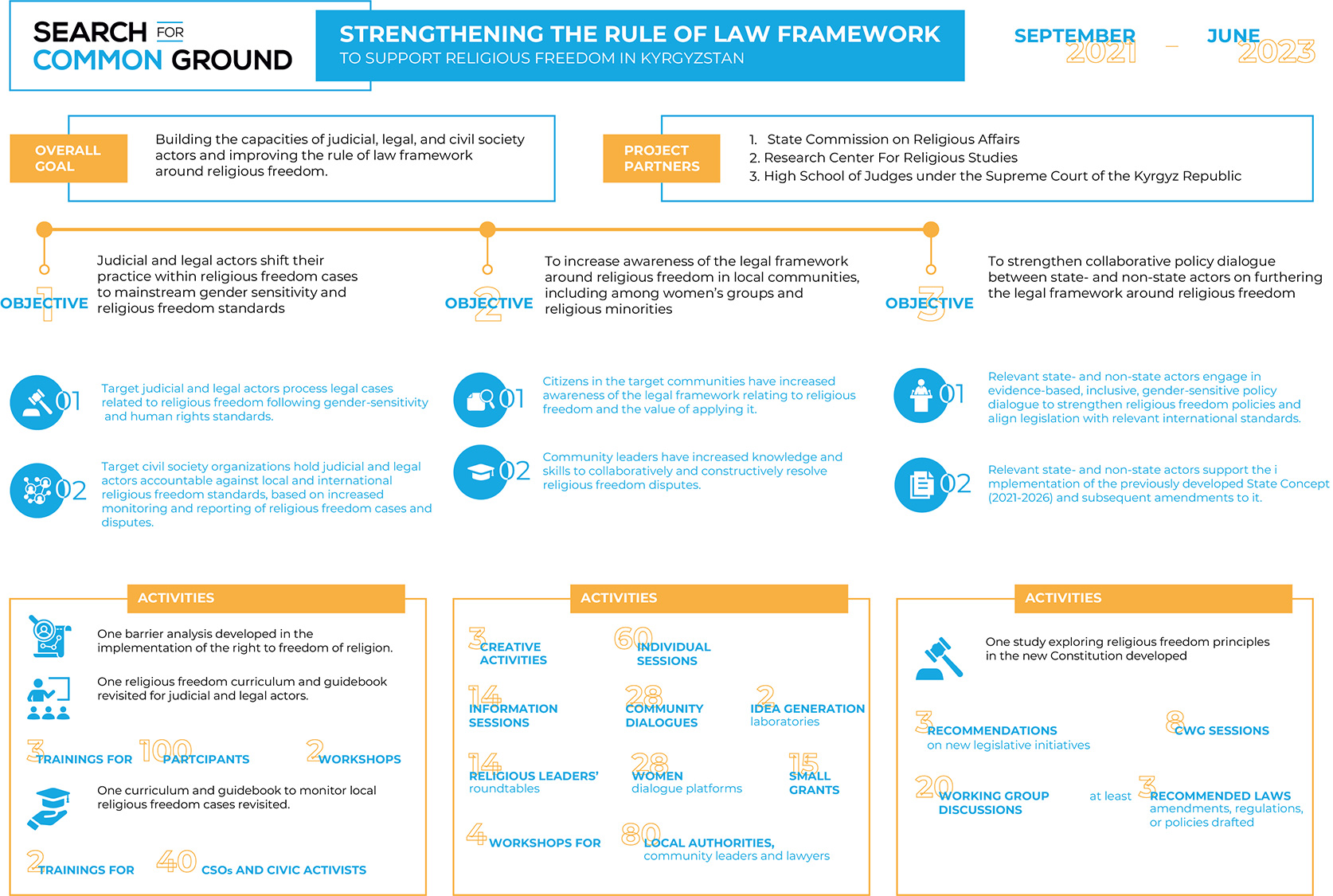
Core Objectives and Activities
The project seeks to achieve its primary objective through three main targeted outcomes:
- Judicial and legal actors shift their practice within religious freedom cases to mainstream sensitivity to women’s issues and religious freedom standards.
- To increase awareness of the legal framework around religious freedom in local communities, including among women’s groups and religious minorities.
- To strengthen collaborative policy dialogue between state- and non-state actors on furthering the legal framework around religious freedom.
In order to achieve these objectives, Search and its partners will engage with judicial and legal actors, building their capacity to process legal cases in line with international standards to ensure full enjoyment of religious rights and mainstreaming sensitivity to women’s issues. Search will facilitate the collaboration of legal actors to take effective measures to prevent and eliminate the discrimination on religous ground. Search will also empower civil society organizations to monitor the implementation of religious rights, administration of justice and document bureaucratic challenges faced by religious organizations.
On the state level, Search will work with relevant state and non-state actors to engage in evidence-based, inclusive, women’s issues-sensitive policy dialogue to strengthen religious freedom policies and align legislation with relevant international standards, while also supporting the implementation of the new State Concept and its Action Plan. Search plans to achieve this through regular Consultative Working Group meetings and follow-up task force to improve state policy and legislation in religious areas.
In parallel, with this actor engagement, Search will improve the interfaith dialogue and tolerance among rural communities through trust-building activities, community dialogue meetings and creative generation laboratories to empower local communities’ initiatives. Search will continue to capacitate local authorities and community leaders with grievance resolutions mechanism tools to collaboratively and constructively resolve community dialogues.
